Debt-to-Income (DTI) Ratio: The Simple, Friendly Guide For Homebuyers
I’m Brett with Turner Mortgage Team. THANK YOU for being here! Let’s make DTI easy. Because when you understand DTI, you shop smarter, get approved faster, and close on time. GOOD NEWS: you can absolutely master this!
Quick Definition
DTI = how much of your gross monthly income goes to monthly debts.
Lenders use it to check if the new mortgage payment fits your budget safely.
The Formula
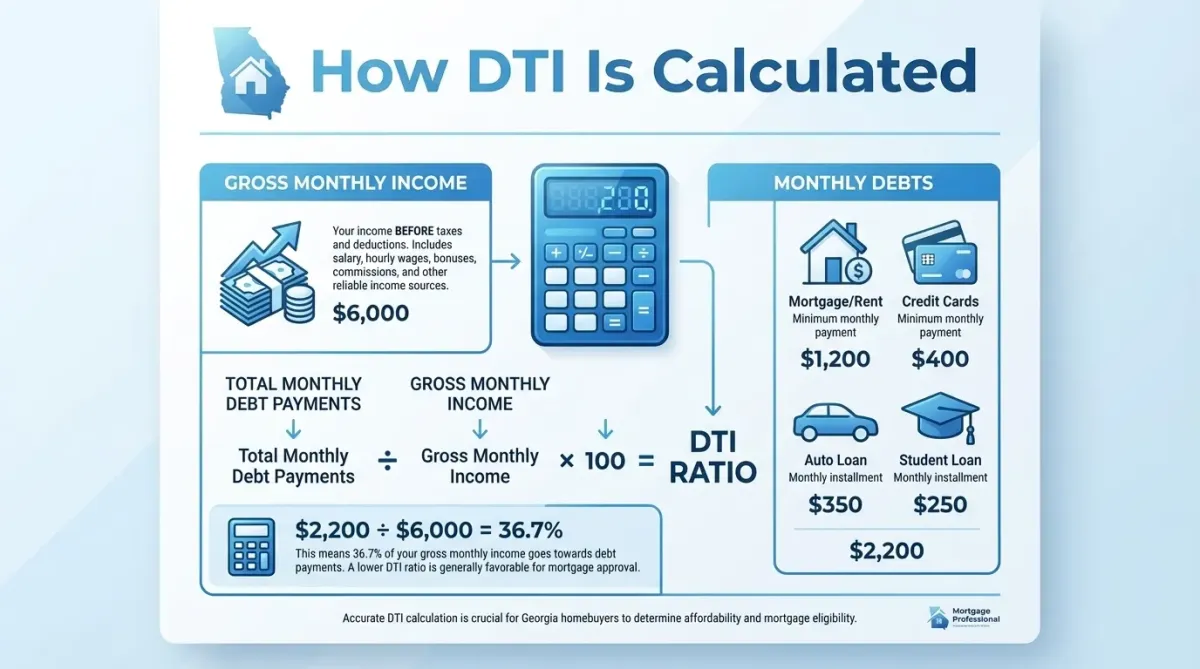
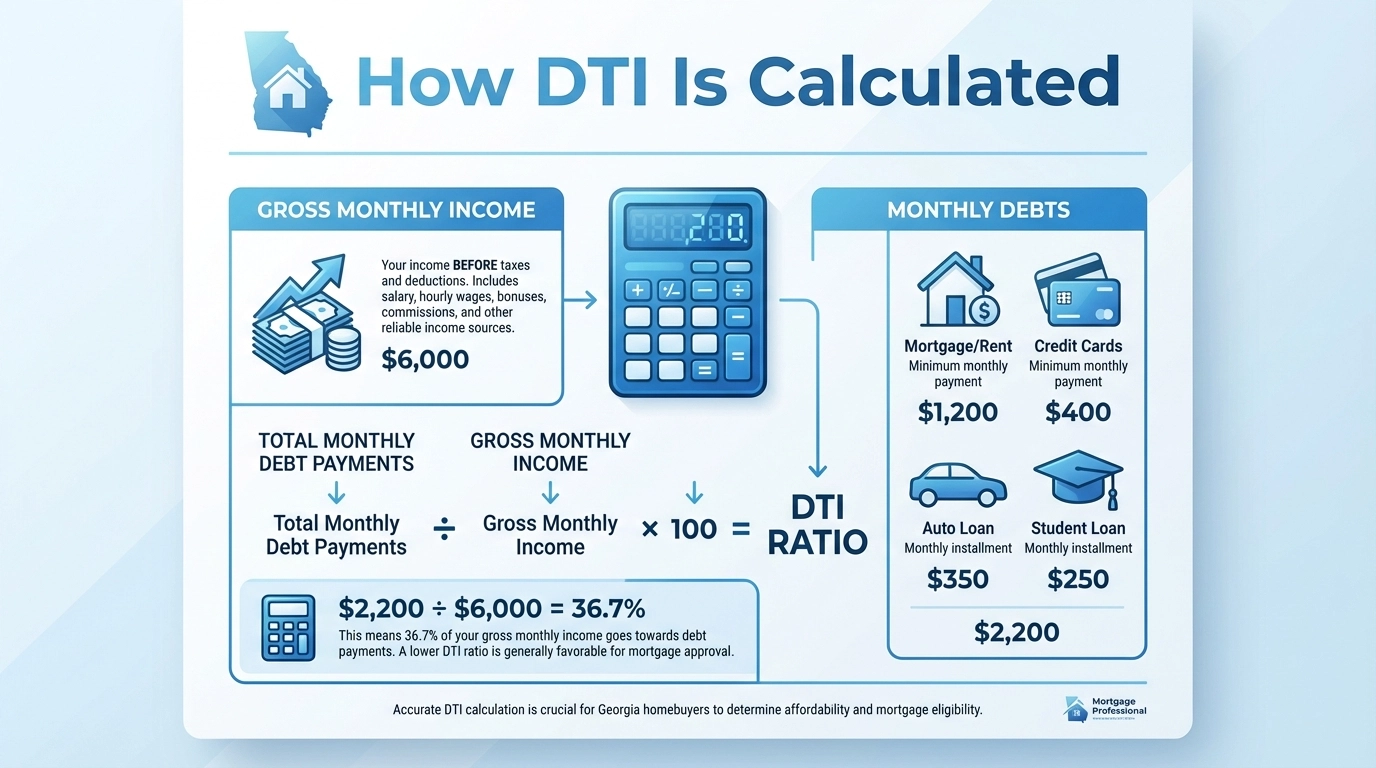
Total Monthly Debt Payments ÷ Gross Monthly Income × 100 = DTI Ratio
Example: $2,200 in debts ÷ $6,000 income = 0.3667 → 36.7% DTI
Front-End vs Back-End DTI (Know the Difference!)
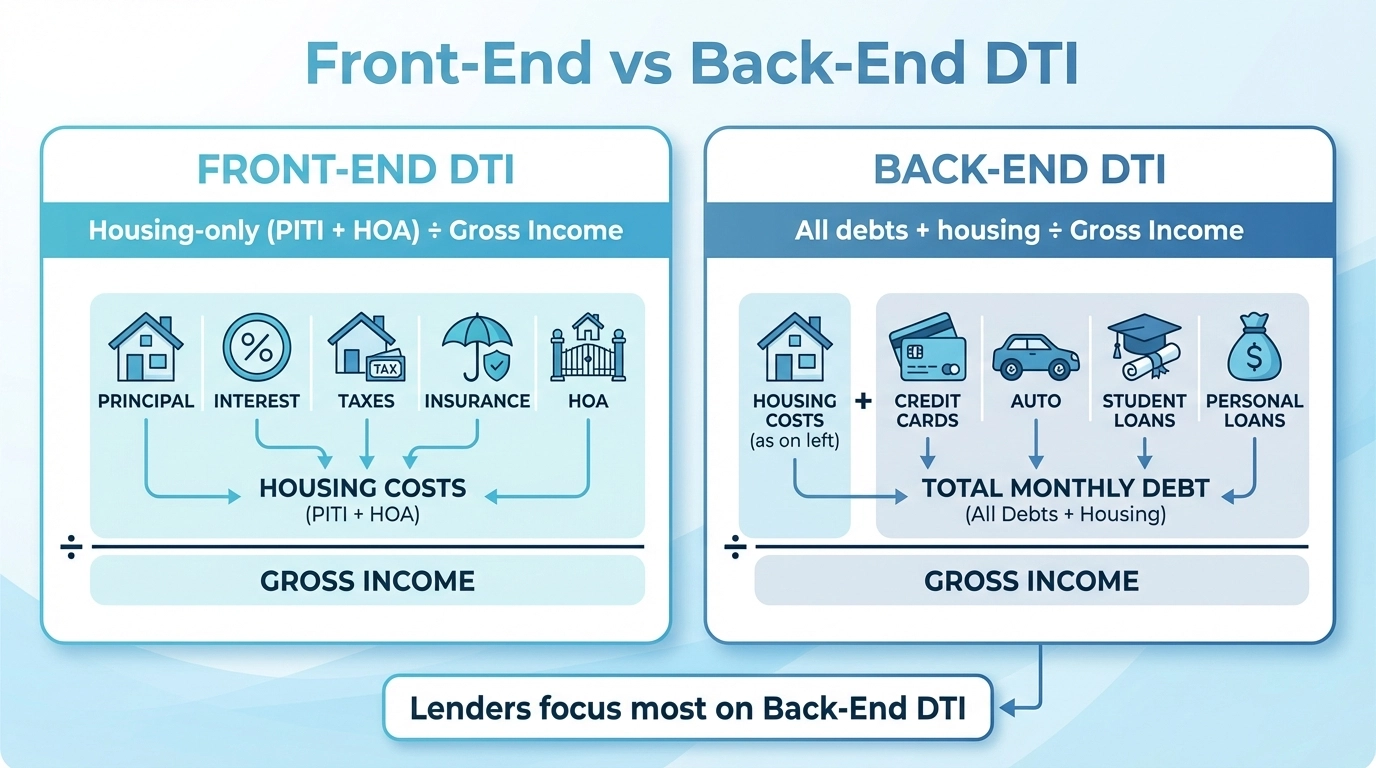
Front-End DTI (a.k.a. housing ratio): Proposed total house payment only (PITI + HOA + mortgage insurance) ÷ gross monthly income.
Back-End DTI: All monthly debts including the proposed house payment ÷ gross monthly income. This is the big one most lenders care about.
PITI = Principal + Interest + Property Taxes + Homeowner’s Insurance (+ Mortgage Insurance, if applicable)
What Debts Count (Included) vs Don’t Count (Excluded)
Included in DTI:
Proposed mortgage payment (PITI + HOA dues, if any)
Minimum credit card payments
Auto, personal, and installment loans
Student loans (actual payment; if none reporting, program rules may apply)
Child support, alimony, and court-ordered payments
Tax installment plans
HELOC minimum payment
Co-signed loans (if you’re liable and no 12-month proof of someone else paying)
Usually excluded from DTI:
Utilities, phones, internet, streaming, and subscriptions
Groceries, gas, childcare/daycare (unless required by specific programs)
Car insurance, health insurance, and general living expenses
401(k)/retirement contributions
401(k) loan payments are typically excluded, but some lenders may consider them—ask us
Note: Student loan treatment varies by program and underwriting system. We’ll guide you so it’s done right.
Ideal DTI Targets by Loan Type
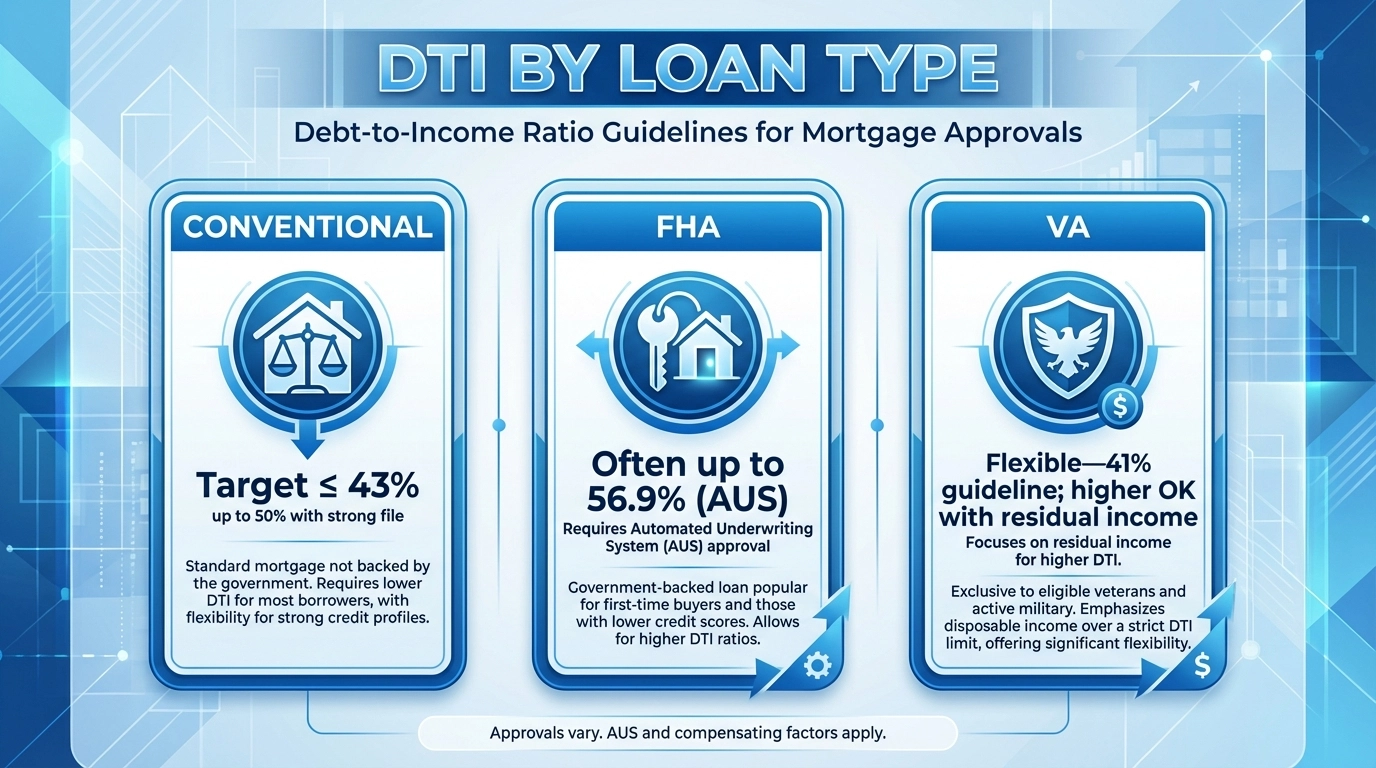
These are common caps when the automated underwriting system (AUS) approves the file and other strengths are present. Your exact approval can vary.
Conventional: Aim for ≤ 43%; up to 50% is possible with strong factors
FHA: Often up to 56.9% back-end DTI with AUS approval
VA: Very flexible; 41% is a guideline, but approvals higher are common if residual income and other factors check out
Important: AUS findings, credit profile, reserves, and property factors all matter. We’ll run scenarios for you - no guesswork!
How To Calculate DTI (Step-by-Step)
Add up your monthly debt minimums (see Included list).
Estimate your new total house payment (PITI + HOA).
Add them together for back-end DTI.
Divide by your gross monthly income (before taxes).
Multiply by 100 to get a percentage.
Calculator-Style Example 1 (Conventional Scenario)
Inputs:
Gross Monthly Income: $6,000
Proposed PITI: $1,800
HOA: $0
Car Loan: $350
Student Loan: $75
Credit Cards (minimums): $125
Calculations:
Front-End DTI = $1,800 ÷ $6,000 = 30.0%
Back-End DTI = ($1,800 + $350 + $75 + $125) ÷ $6,000
Back-End DTI = $2,350 ÷ $6,000 = 39.2%
Result:
30% / 39.2% is comfortable for many Conventional approvals.
Calculator-Style Example 2 (FHA Flexibility)
Inputs:
Gross Monthly Income: $5,500
Proposed PITI: $2,100
Car Loan: $500
Student Loan: $200
Credit Cards: $100
Calculations:
Front-End DTI = $2,100 ÷ $5,500 = 38.2%
Back-End DTI = ($2,100 + $500 + $200 + $100) ÷ $5,500
Back-End DTI = $2,900 ÷ $5,500 = 52.7%
Result:
52.7% can be within FHA’s typical AUS-approval range (often up to 56.9%). Strong chance with solid credit and compensating factors.
Calculator-Style Example 3 (VA - More About Residual Income)
Inputs:
Gross Monthly Income: $6,500
Proposed PITI: $2,400
Car Loan: $300
Credit Cards: $100
Calculations:
Back-End DTI = ($2,400 + $300 + $100) ÷ $6,500
Back-End DTI = $2,800 ÷ $6,500 = 43.1%
Result:
VA looks hard at “residual income” by family size/region. A 43.1% DTI can be fine if residual income passes and overall profile is solid.
Why DTI Matters To Lenders
Ability-to-Repay (ATR) and Qualified Mortgage (QM) rules: DTI is a core risk metric.
Predicts payment stress: Lower DTI = lower risk of default.
AUS decisions: Your DTI, credit, assets, and property all interact to produce an approval.
Bottom line: A right-sized DTI helps you lock in the home you love - confidently and on time.
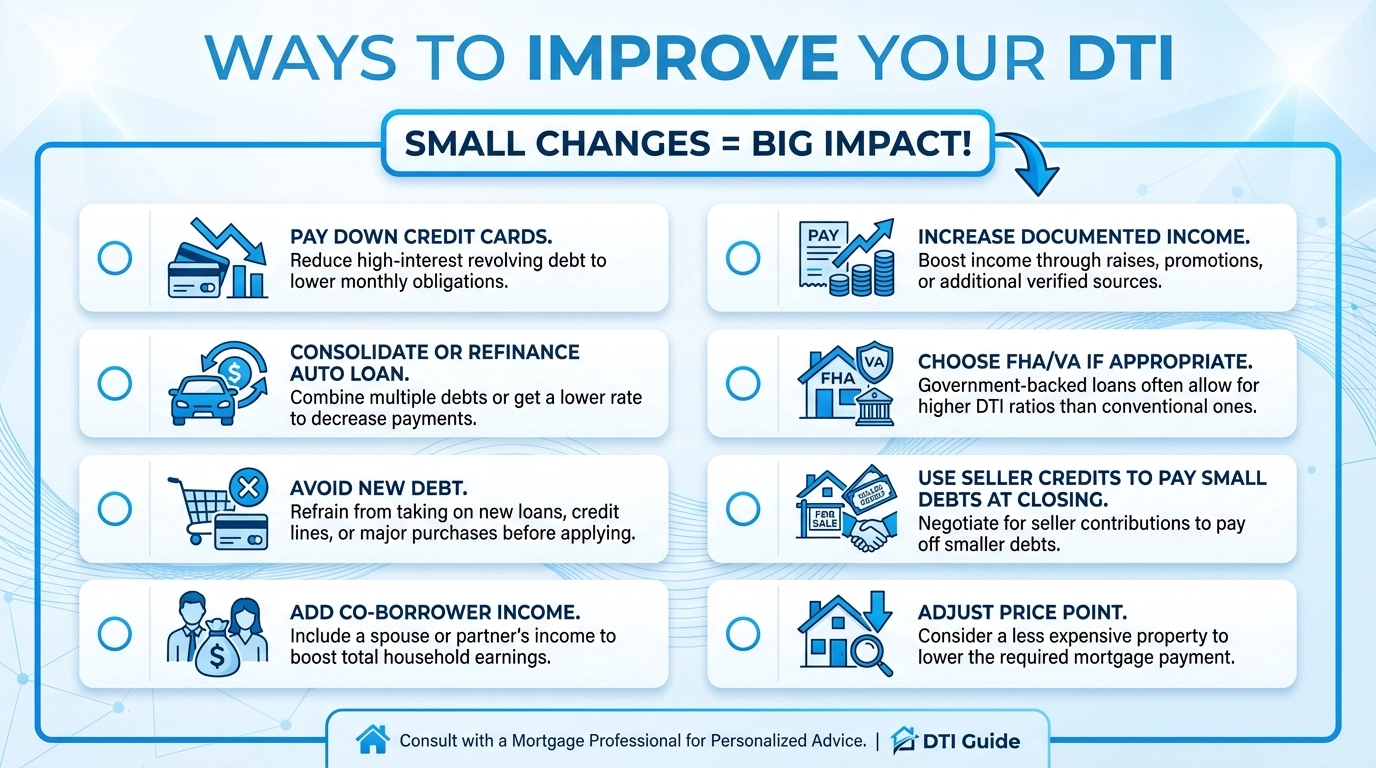
Simple Ways To Improve Your DTI (FAST WINS!)
Pay down revolving balances to reduce minimums. Even $500 can drop the reported payment and your DTI!
Eliminate a small installment loan. Zeroing out a $40–$75 payment often moves the needle.
Avoid new debt and don’t co-sign before closing.
Increase verifiable income. Overtime, bonuses, or a part-time W-2 can help once documented.
Add a co-borrower with income and low debts.
Consider a longer loan term on auto debt to lower the monthly payment (be mindful of interest cost).
Choose the right loan program. FHA can allow higher DTI; VA can be flexible with strong residual income.
Pick the right price point. Adjust the target payment to fit within the approval window.
Use seller credits to pay off small debts at closing (if allowed by program). Smart and strategic!
Pro tip: A temporary rate buydown usually does not lower the qualifying payment. A permanent buydown might. We’ll model both for you.
DTI “Napkin Calculator” You Can Use Right Now
Write your gross monthly income at the top.
Estimate your monthly house payment (PITI + HOA).
List your other monthly debt minimums.
Add up the debts. Divide by income. That’s your DTI!
Aim for:
Conventional: ≤ 43% target; ≤ 50% possible
FHA: ≤ 56.9% possible
VA: Flexible—residual income is key
FAQs
Does rent count? Only the new proposed mortgage payment counts in the new DTI. Your current rent is not included unless required for a specific calculation.
Do utilities and subscriptions count? No.
What about student loans on income-driven plans? We use the documented payment. If none reports, program rules apply (we’ll advise case-by-case).
Can I get approved above these numbers? Sometimes yes, with AUS approval and strong compensating factors.
Is net income used? No, DTI uses gross income (before taxes) in most cases.
THANK YOU For Reading! Let’s Talk Through Your Numbers
We’re here to make this EASY and CLEAR - no guesswork, no stress. THANK YOU for the opportunity to serve you!
Turner Mortgage Team
Brett Turner, Mortgage Loan Officer
Serving Georgia, Tennessee, and Florida
Get Pre-Approved: https://turnermortgageteam.com
Questions right now? Reach out and we’ll run your exact scenario and give you a game plan!


